
7. Pathways: Split Between Catalog and Content#
Status#
Draft
Context#
Courses in openedx-core already separate the catalog side (openedx_catalog: CatalogCourse,
CourseRun - what learners browse and enroll against) from the content side (openedx_content - what is
authored, versioned, and published). Pathways have the same two aspects, and the same reasons to keep them apart:
Different change rates. The display name, description shown in the catalog, and SEO metadata are revised frequently and casually. The definition of what a learner must do to complete the Pathway changes rarely and deliberately.
Different people doing the editing. Catalog data is typically maintained by marketing or communications staff; the Pathway definition is maintained by content authors. Both are visible to learners, so the distinction is about who edits what, not about who can see it.
Different permissions follow from that. We expect instances to want to let marketing staff update catalog copy without granting them the ability to change what learners must complete, and vice versa. Keeping the two apart makes that possible without inventing field-level permissions. However, with the new RBAC system, this may be less of a concern.
Auditability. Progress and credentials must be judged against the definition that was in effect at the time, which requires versioning the definition - but versioning catalog copy would be pure overhead.
Decisions#
A Pathway is split into two parts:
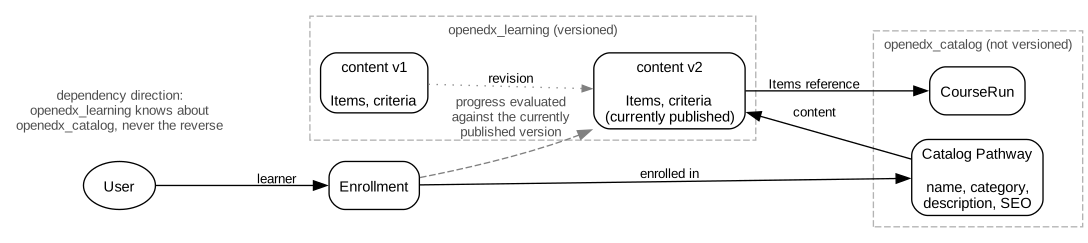
Catalog Pathway - the learner-browsable, enrollable thing. It includes the display name, the description shown in the catalog, SEO metadata, and a Category. It is not versioned. Its definition lives in the
openedx_catalogapp.Pathway content - the definition of the Pathway: its Items and its completion criteria. The content is versioned, so that we can always tell what the definition was at any given moment. A version of the Pathway content implements a Catalog Pathway.
The Category is a student-facing label for the kind of Pathway (e.g. “Master’s Degree”, “Annual Training”). Learners see the Category rather than the word “Pathway”. It is always required: rather than falling back to “Pathway” in code, we ship a default database entry with that name, so the behavior is uniform and operators can rename or extend the set without a code change.
In authoring contexts (Studio, Django admin, code, docs), the terminology is always “Pathway”, with the Category shown explicitly. Relabelling is a learner-facing concern of the catalog side only.
Content implementation: The models that define pathway content are part of the
openedx_learningpackage, which lives above bothopenedx_contentandopenedx_catalog. This has the following consequences:The implementation of the Pathway feature is mostly contained within
openedx_learningrather than spread amongopenedx_catalog,openedx_learning, andopenedx_content.Pathway Items/Criteria are treated as part of the Pathways feature, and are not generic content primitives available for use in non-pathway features.
Pathway Items can be implemented using
PublishableEntity, to get versioning and draft/publish.Pathway Items may reference
CourseRunentities directly.Pathway Items, completion criteria, etc. cannot be used nor referenced in core
openedx_contentmodels such asComponent(but could be referenced by a genericContainerthat allows anyPublishableEntityas its child, or a specializedContainersubclass defined inopenedx_learning, if either were useful).
Enrollment ties a learner to a Catalog Pathway. Progress is evaluated against the currently published content version, not against a version frozen at enrollment time, so that authoring changes reach learners who are already enrolled.
Example content of each model:
Catalog Pathway |
Pathway content |
|---|---|
Display name |
Pathway Items |
Category |
Completion criteria |
Description |
References to CourseRuns |
SEO metadata |
|
Enrollment |
|
Link to the Pathway content |
Consequences#
Catalog edits never create new content versions; definition edits (Items, criteria) always do.
Because evaluation follows the published version rather than the enrollment-time version, edits to a Pathway apply to learners who are already enrolled, which is what we want, but it means edits need care and re-evaluation.
The unversioned Catalog Pathway can be long-lived even if its content definition is changed significantly over time.
Changelog#
2026-09-14:
Changed layering so that
openedx_catalogdepends onopenedx_content, not vice versa.
2026-09-01:
Initial version